I used to think writing a cookbook meant months of recipe testing, formatting headaches, and a prayer. I was wrong.
I've published on Amazon KDP for years. I know what a cookbook is supposed to cost, in time and money and sanity. Then I built one in a single session, printed it at home, and my wife asked how I did it. That's when I had to rethink everything I assumed about how a cookbook gets made.
Let me get the embarrassing part out of the way first.
I used to think the only real cookbook was the kind where someone spent six months in a kitchen. Testing recipes. Taking notes. Hiring a food photographer. Paying a designer to lay out every page so the margins looked right. That was the work. That was the price of a real book.
And honestly? That belief worked fine for a long time. It kept me from even trying.
Then I built BookMasher with my partner Wayne Atkinson. We'd spent a decade building publishing and marketing tools for our own business. We publish on Amazon KDP ourselves. So when we started thinking about a cookbook module, I figured I'd test it on something personal.
My wife has been trying to get me to eat gluten-free. I'll be honest: some of it tastes like paper. So I sat down in one session and built something I called *The $5 Gluten-Free Plate* using BookMasher's magazine-inspired cookbook layout. Downloaded it as a PDF. Printed it at home. Handed it to her.
She said, "Oh, this is beautiful. How'd you do this?"
That was the moment I stopped thinking about cookbooks the old way.
Here's the whole thing.
- Why the old cookbook process breaks most people before they finish
- What actually happened when I tested the magazine cookbook module on my wife
- How the illustrated, magazine-style layout works and why it matters for KDP
- The honest case for who this is and is not right for
- What ten book types in one tool actually means for a publisher
- What real users are saying after publishing cookbooks with BookMasher
- The simplest next step if you want to be a cookbook author by tonight
Why the cookbook dream dies on page one
Most people who want to publish a cookbook don't fail because they can't cook. They fail because the process between "I have recipes" and "I have a book on Amazon" is genuinely brutal.
You need the recipes written in a consistent format. You need headnotes. You need food photos that don't look like they were taken on a Tuesday with the wrong lighting. You need a layout that doesn't look like a Word document. You need front and back covers. You need to figure out KDP's file requirements without losing your mind at midnight.
That's not a recipe problem. That's a production problem.
And if you've tried handing your idea to a general AI tool, you already know what comes back: paragraphs of text that read like a terms-of-service agreement happened to be about pasta. Content you'd never put your name on.
The tool was the problem, not the person holding it.
That's the line I kept coming back to when we were building this thing. The frustrated people weren't bad at cooking or bad at business. They just ran into a process that wasn't built for them.
The moment it changed
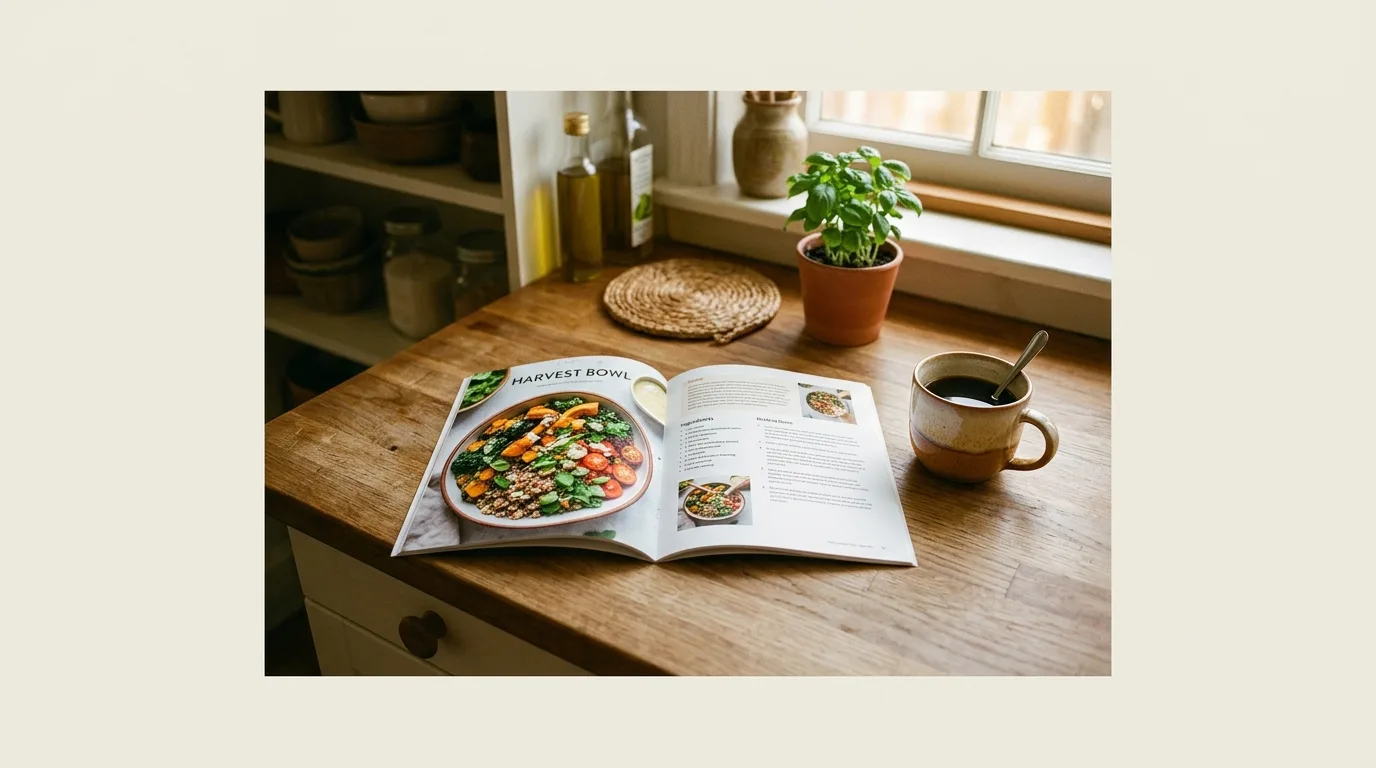
When I handed my wife that gluten-free cookbook, I wasn't thinking about positioning or marketing. I was genuinely curious whether the output would hold up when someone who had no idea it was AI-generated looked at it.
She had no idea. The magazine-style layout, the recipe headnotes, the food illustrations, it looked like something that belonged on a kitchen shelf. She asked me how I did it. She had no idea it had been built in the same session I was using to demo the software.
That was the proof I needed. Not a conversion rate. Not a testimonial. My wife couldn't tell, in the best possible way.
That's what the magazine-inspired cookbook module actually does. It's not a template you fill in. You bring a topic, a cuisine, a dietary angle, whatever you know. BookMasher writes the recipes: ingredients, headnotes, numbered steps, and measurements in the format you choose, US or metric. Then it illustrates every page with food photography-style images generated to match. Then it wraps the whole thing in a layout that looks like it came out of a food magazine, not a print-on-demand assembly line.
Cover and back cover included. KDP-ready files out the other end.
What the magazine cookbook module actually does
This is worth being specific about, because "AI writes your cookbook" could mean anything.
BookMasher's cookbook module was rebuilt from the ground up for Version 2. The layout engine generates real magazine-grade recipe pages. Not a stock template. Not a grid you populate with your own photos. The images are generated to match your specific recipes and your specific style, page by page.
Here's how simple the input side is:
- Pick your topic. A cuisine, a dietary style, an ingredient focus, a theme.
- Choose your tone and your author. BookMasher can generate a pen name with a bio and a headshot, or you publish under your own name.
- Hit Generate.
Most users have a complete illustrated first draft done within the same session.
That's the whole job description on your end. The rest, the writing, the illustrations, the formatting, the covers, BookMasher handles.
And if one image comes out wrong, you redo just that one. Not the whole book. That's a new Version 2 control that sounds small until you've ever scrapped an entire project because one page looked off.
| The old way | The new way |
|---|---|
| Hire a recipe developer and pay for every recipe | Topic in, recipes written and formatted automatically |
| Food photographer plus editing | Illustrations generated to match your recipes, page by page |
| Designer for layout and covers | Magazine-grade layout with front and back covers, included |
| Learn KDP formatting requirements | KDP-ready PDF and EPUB files, exported in one click |
| Weeks or months of production | Most users finish a first draft in the same session |
I'm not going to pretend the old way is dead. If you have a design background and a professional kitchen and six months, you can make something extraordinary by hand. That path is real.
But that's not who comes to BookMasher. The people who come here are coaches who want a lead magnet that looks like a real book. Creators with a food niche who want something on Amazon before the algorithm forgets them. First-time publishers who have recipes in their head and a life that doesn't allow for a six-month project.
For those people, the old way doesn't just take longer. It doesn't happen at all.
Why I kept doing it the old way anyway
Here's my honest confession: even after we built the first version of BookMasher, I still thought of AI-assisted books as something you'd have to apologize for. Like the quality ceiling was lower. Like you'd have to do a lot of cleanup before you could show anyone.
I kept that assumption quietly, even while we were building the tool.
The thing that changed my mind wasn't a demo. It was my wife not knowing the difference.
When a person who didn't know she was looking at AI output looked at it and saw a real cookbook, I had to update my mental model. Not because of anything I told myself. Because of what I saw.
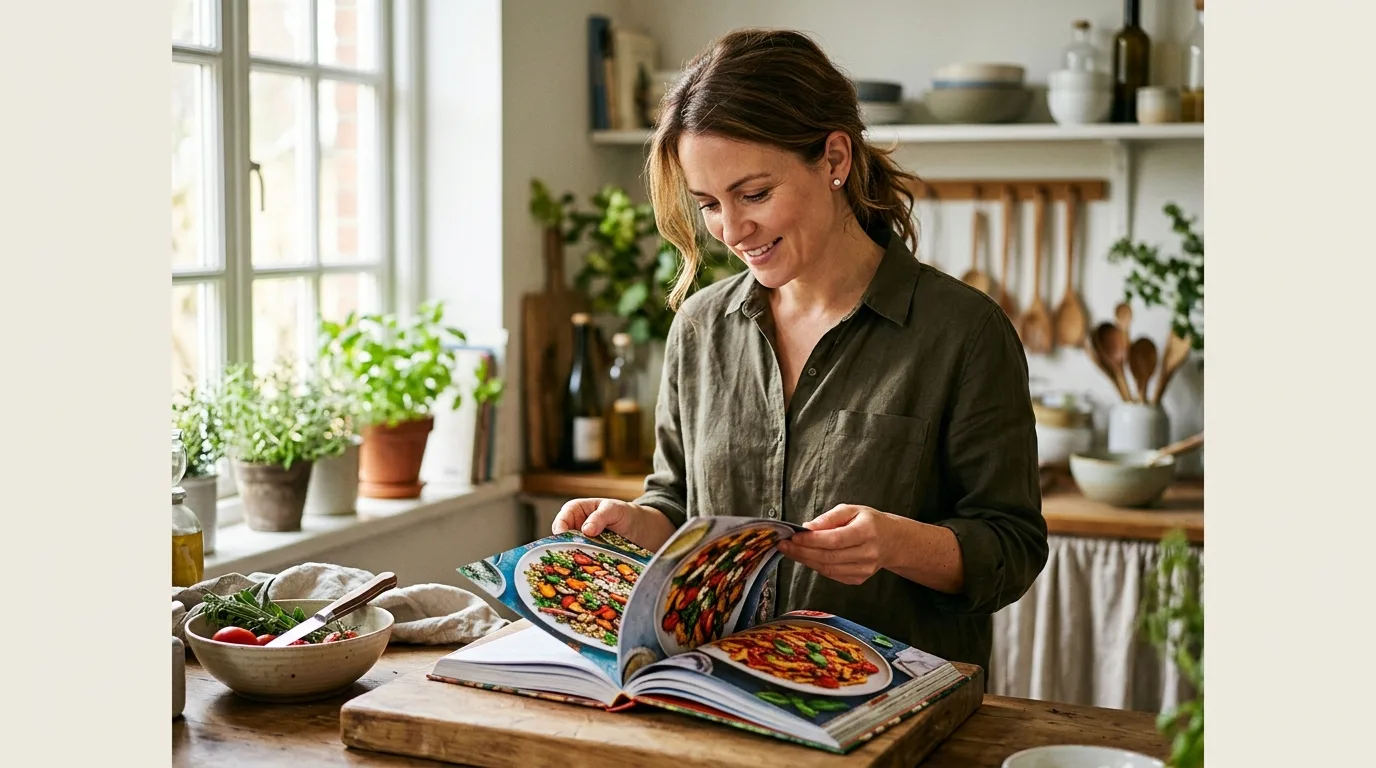
Ten modules, not one trick
Here is where I want to be straight with you about something, because it actually matters.
A lot of tools that say "AI writes your book" do one thing. One genre, maybe two. You get a children's book tool or a recipe tool, and that's the whole product.
BookMasher has ten book types, all in one place. Children's books. Cookbooks. Coloring books. Travel guides. Coffee table books. DIY books. Gardening books. Crossword puzzle books. Word search books. Problem-solving books.
The cookbook module is the focus here because the magazine-style layout is genuinely something different, it's the kind of output that makes people stop and ask how you did it. But you're not buying a cookbook tool. You're buying access to ten publishing modules that share one interface, one set of credits, and one export workflow.
My own xeriscaping book, a gardening title I published two years ago, priced at $4.99 on Kindle, with no promotion since I put it up, still sells 5 to 10 copies a month and sits at number 170 in its Amazon category. I've never touched it since I published it. That's what a niche non-fiction book on Amazon can do when it's properly formatted and sitting in the right category.
The cookbook module is the most visually striking thing BookMasher does. But the catalog effect, multiple books across multiple niches, all under one tool, is where the real long game lives.
If you want to see what the magazine cookbook module produces before you commit to anything, the $7 trial gives you full access and most users have a first draft done in the same session.
Start my book for $7 →What it looks like when it works
Topic in, magazine cookbook out, KDP files ready to upload.
Formatting, illustrations, layout, cover design, file prep, manually.
Here is what the cookbook build actually produces, step by step:
- Recipe content written with headnotes, ingredients, and numbered steps in your chosen format.
- Food-style illustrations generated to match each recipe, not pulled from a stock library.
- Magazine-grade layout applied across every page, cover to cover.
- Front and back covers with your title, summary, and author bio included.
- PDF and EPUB files built to KDP's formatting standards, ready to export and upload.
And because this is Version 2, you get the small controls that matter. Hate one illustration? Re-roll just that one. Changed your mind on a character name? Replace it across the whole book in one click. Want to use your own photos for certain pages? Drop them in and BookMasher fills the rest.
The bonuses that come with every account are worth naming too, because the Video Promo Maker alone changes how you think about getting your cookbook in front of people. It turns your finished book into a short animated promo video, your cover and illustrations in motion, sized for Reels, Shorts, and TikTok. Most cookbook authors put that job off until after they publish. BookMasher does it the same day.
What people who've done this are saying
These are real customers who used BookMasher to publish cookbooks and multi-book catalogs. Their words, not mine.
“I was able to get my recipe book done in, like, a very short period of time. It writes way better than anything I could have imagined.”
Scott Paton“I'm Steve Bailey, and this tool has allowed me to create multiple cookbooks in just a couple of hours. It has honestly taken more time to read them myself and get up to speed on what I'm professing to know. [...]”
Steve Bailey“I wrote 3 books this last Saturday. A cookbook, a Problem Solving book, and a Gardening book. All with amazing content and images.”
Scott RogersResults may vary.
Three separate people. Three separate experiences. The same basic result: a cookbook that looked real, produced in a sitting, ready to publish.
Why this keeps working when trends change
AI tools come and go. Some of them flash and disappear because the underlying model changes or the team stops updating the product.
Wayne and I have been building Masher tools for our own business for a decade. BookMasher isn't an experiment we're watching from the outside. We publish on KDP ourselves. We use the tool ourselves. Version 2 was a complete ground-up rewrite because we wanted the platform stable enough that an AI agent could be told to write a children's book and do it without human intervention. That's how seriously we took the rebuild.
The cookbook module got the same treatment. The magazine-style layout, the recipe formatting engine, the metric and US measurement toggle, those aren't cosmetic updates. They're what you need when the output has to look like something a professional made.
A book that looks like a real book keeps selling long after the session that made it.
My xeriscaping book proves that. It's been earning quietly for two years on zero promotion. The cookbook you build today can do the same thing.
What it turns into once it's running
The $7 trial is open right now and gives you full access to the cookbook module and all ten book types. Most users have a complete illustrated first draft done within the same session.
See how BookMasher works →If you want to try this
I'm not going to pretend a post can decide this for you. You know your situation better than I do.
What I can tell you is what BookMasher actually is: a tool that takes a topic and hands back a complete, illustrated, magazine-style cookbook formatted for Amazon KDP. You add your stories, your voice, your expertise on top. The heavy lifting, the writing, the illustrations, the layout, the covers, the export files, BookMasher does that part.
The trial is $7 for seven days. Cancel anytime inside those seven days and you're only ever out seven dollars. If you go lifetime, there's a seven-day, no-questions money-back guarantee on that too.
If a real, illustrated cookbook with your name on it sounds like something you'd like to have by tonight, the next step is pretty simple.
7-day trial for $7 · Cancel anytime, no contract